Water Conditioning
Salt-Based Softeners vs. Salt-Free Conditioners in Minnesota
Compare hardness removal and scale conditioning, including what certification can and cannot establish.
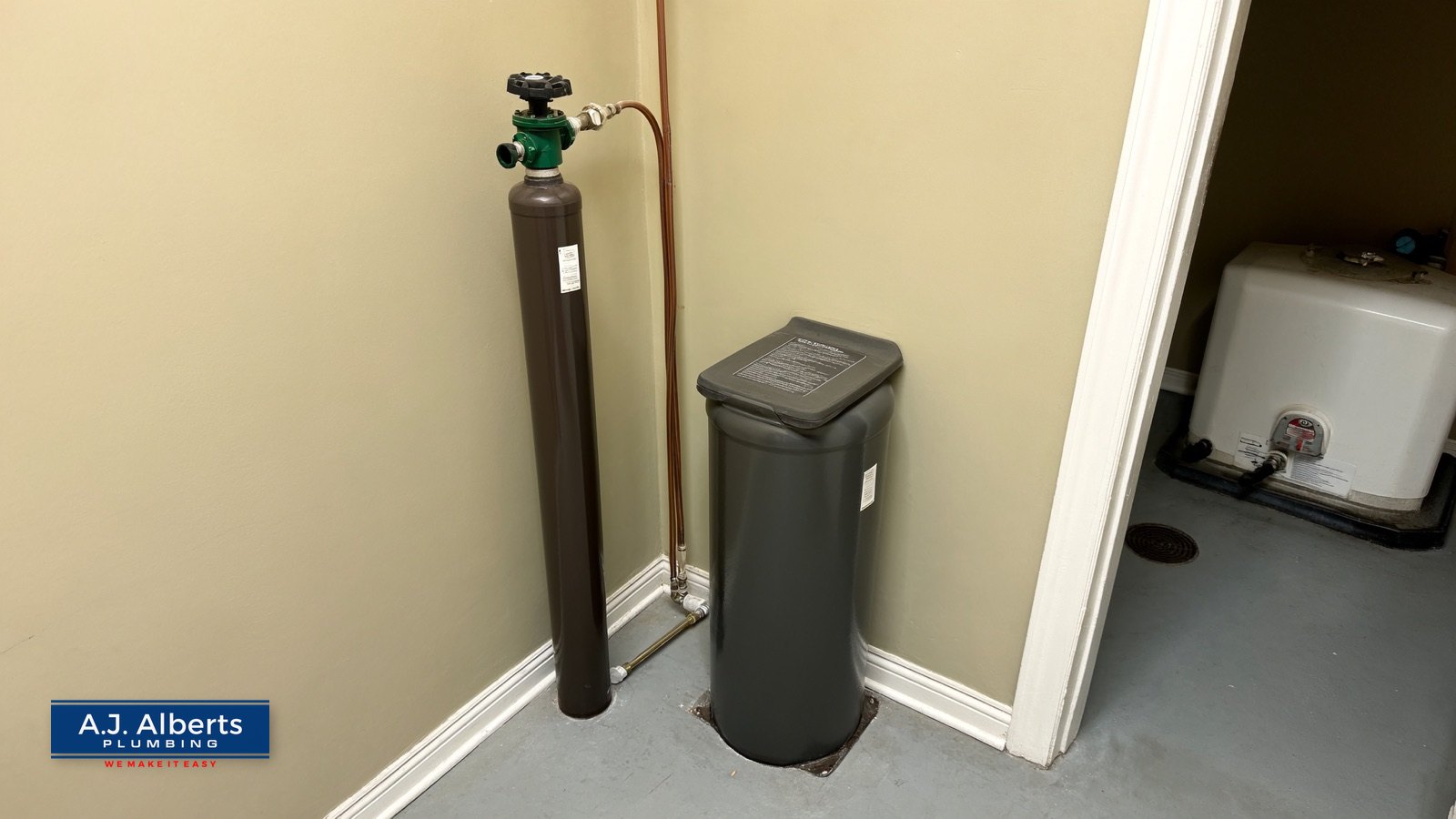
Conventional salt-based softeners remove hardness minerals through ion exchange. Many salt-free conditioners aim to control scale while leaving those minerals in the water. Compare the exact product and desired result before choosing either approach.
The difference is measurable
If your goal is lower hardness, ask for before-and-after hardness readings and the exact equipment performance claim. A change in scale behavior is not the same measurement as removing calcium and magnesium.
The University of Minnesota distinguishes softening from alternative conditioning and advises buyers to examine alternative product claims carefully. It also recognizes reverse osmosis as a proven membrane treatment, so it would be inaccurate to say salt regeneration is the only technology capable of reducing hardness.
Read certification in context
NSF/ANSI 44 covers residential cation-exchange softeners regenerated with sodium or potassium chloride. It is useful when evaluating that category of equipment. It is not a universal certification for every scale-control technology, and lack of that particular standard does not by itself prove that an unrelated technology cannot work.
Ask for documentation supporting the exact result being advertised. Model, flow, inlet-water conditions, and maintenance requirements all belong in the comparison.
Consider the water going into the system
Measured hardness, iron, and other water chemistry can affect treatment design. A scale conditioner is not automatically an iron filter or a PFAS treatment. Avoid choosing from a citywide estimated hardness number.
If the concern is a specific contaminant, review the relevant test and certification claim separately from the scale decision.
Compare upkeep and environmental effects
Ion-exchange softeners use regenerant and discharge chloride. Demand-initiated operation can reduce unnecessary regeneration compared with a fixed timer, but savings depend on the equipment and baseline. Do not assume a quoted percentage is a guarantee for your home.
Other systems can still require cartridges, media changes, or other service. Ask for the manufacturer’s schedule and ongoing costs. A salt-free label does not mean maintenance-free.
See our softener installation service and water conditioning overview.
Start with the right test
The free basic in-home test checks hardness, iron, chlorine, pH, total dissolved solids, and alkalinity, plus nitrate for well-water customers. It does not measure PFAS or establish drinking-water safety.
A.J. Alberts offers separate paid PFAS testing for municipal-water and private-well customers. We collect and submit the sample and explain the laboratory report. Ask about the scope and price when booking.
Schedule a free basic water test or call 651-738-0580. For PFAS testing, identify that request when you contact us.
Sources
Frequently Asked Questions
Does a salt-free conditioner remove hardness?
What does NSF/ANSI 44 cover?
Is a salt-free system maintenance-free?
Need Help in the Twin Cities?
Free in-home water test. Written upfront pricing. Lifetime craftsmanship warranty.